


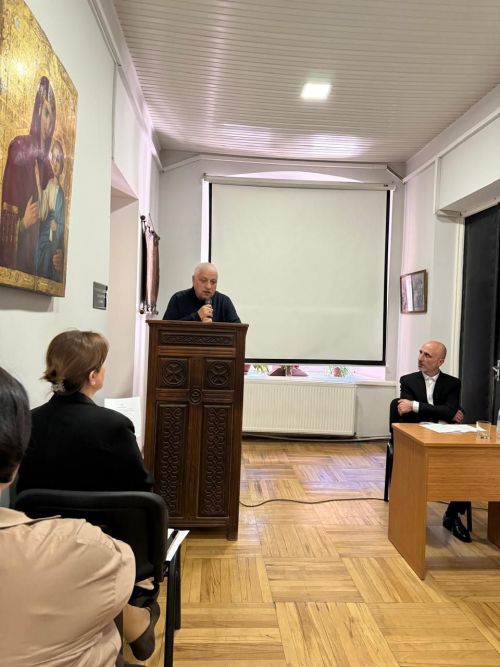
On May 20, the Annual Scientific Conference of Professors and Instructors, dedicated to His Holiness Ilia II, Catholicos-Patriarch of All Georgia, opened at the Tbilisi Theological Academy and Seminary. The conference will continue for three days and will serve as a summary of the scientific and research activities carried out by the professors and instructors throughout the year.
On the first day of the conference, a plenary session was held. It was opened with a welcoming address by the Rector of the Tbilisi Theological Academy and Seminary, Doctor of Theology, Philology, and Political Sciences, Professor, Protosyngellos Giorgi Zviadadze. He spoke about the significance of academic conferences in the educational activities of the Theological Academy and Seminary as well as the importance of the work carried out in this field by the Catholicos-Patriarch of All Georgia, the late Ilia II, and the commitment to the traditions established by him.
The plenary session was chaired by Doctor of Philology Khatuna Kalandarishvili.
The following participants presented their papers at the plenary session:
Doctor of Philology and Theology, Academician of the Gelati Academy of Sciences, Professor, Archpriest Bidzina Gunia – “Lord, Now You Let Your Servant Depart in Peace…”.
Doctor of History and Theology, Professor Sergo Vardosanidze – “What United Us and What Will Unite Us: Historical Parallels”.
Doctor of Philology, Professor Lela Khachidze – “St. Giorgi the Athonite’s ‘The Life of SS. Ioane and Euthymius and the ‘Accounts of Iviron’”.
In his presentation “Lord, Now You Let Your Servant Depart in Peace…”, Archpriest Bidzina Gunia examined the hymn appointed for the conclusion of Vespers and sung in services of all the ranks, holding special significance.
“For a believer who has embarked on the path of salvation, participation in liturgical worship is a fundamental component of spiritual life, where the Divine Liturgy occupies a central place. A deeper understanding of it is rooted in recognizing the significance of the offering of the Eucharistic gifts. For indispensable participation in the Sacrament of the Eucharist, the Savior Himself calls us with these words: “Truly, truly, I say to you: unless you eat the flesh of the Son of Man and drink His blood, you have no life in you” (John 6:53). Accordingly, the redemptive action of the Incarnate Son of God extends to all humanity, thereby granting each person the possibility of deliverance from sin, renewal, rebirth, and restoration to the primordial dignity. And when a person is fully engaged in the liturgical life of the Church, their understanding of the faith and spiritual life become conscious, thoughtful, and purposeful,” — noted Father Bidzina.
On the question – what hinders a person from mindful engagement in liturgical worship? – Father Bidzina answered drawing on the teachings of St. John of Damascus: “The senses are five: sight, hearing, smell, taste, and touch. Likewise, the organs of the senses are five. We must know that, after the Fall into sin and exile, sin enters a person through these five gateways and spiritually harms them, separating the creature from the Creator and drawing them into the turmoil of this world” (Damascene, 2000: 362–365). “Considering the above, the structure and course of the public liturgical service are significant, particularly for the spiritual safeguarding of these five senses, which constitutes the foundation of a person’s deliverance from sin, renewal, rebirth and restoration in the primordial dignity.” – said Father Bidzina.
In his presentation “What United Us and What Will Unite Us: Historical Parallels”, Professor Sergo Vardosanidze discussed the main factors of the historical consolidation of the Georgian people from antiquity to the modern era. Based on written sources, the author examined and discussed the following issues: the role that religious and linguistic consciousness has played and continues to play in the formation of national identity; as well as the experience of confessional diversity and the influence of external empires within the Georgian context. The work places special emphasis on defining the significance of the Christian faith, the Georgian language, and the European civilizational choice in the process of shaping Georgian state consciousness. Accordingly, the speaker concluded by answering the question — What united us, and what will continue to unite us? — as follows:
“Historical experience demonstrates that, in contemporary Georgia, the unifying idea should be founded upon:
state independence — as the supreme value;
Georgian civilizational identity — as a shared cultural space;
the European choice — as a historically affirmed path;
demographic responsibility — as a prerequisite for the survival of the nation.
Only the consolidation of the population around these principles will make it possible for Georgia to meet the geopolitical challenges of the 21st century,” the speaker noted.
Professor Lela Khachidze’s presentation examined correspondence between the historical accounts preserved in St. Giorgi the Athonite’s “The Life of SS. Ioane and Euthymius” and “The Accounts of Iviron”. Based on this analysis, the scholar substantiated the cultural and broader scholarly significance of St. Giorgi the Athonite’s work.
A comparison of the Accounts of Iviron with The Life of SS. Ioane and Euthymius once again demonstrated the accuracy with which St. Giorgi the Athonite portrays the historical realities described in his work.
Below are several excerpts from Professor Lela Khachidze’s presentation:
The life of SS. Ioane and Euthymius is a work of landmark significance and deserves attention for its many aspects. Although it has been extensively studied from historical and philological perspectives, many of its aspects still remain to be explored. Given its importance as a historical monument, the work calls for further research. For a comprehensive study of the monument, it is essential to compare its surviving accounts with the four-volume corpus known as the Accounts of Iviron, as such a comparison is crucial for the analysis and interpretation of its contents. This corpus was published in French between 1985 and 1995 by Jacques Lefort, Nikolaos Oikonomides, Denise Papachryssanthou, and Helen Metreveli. All four volumes were translated into Georgian by Tsisana Bibileishvili and published in 2008.
St. Giorgi the Athonite had specific reasons and aims for writing this work. First and foremost, he was driven by a desire to preserve the memory of the founders of “Iviron” and to affirm the Georgians’ legitimate rights over it. Besides, the material published in the Accounts of Iviron offers a number of new insights, more precisely, clarifications: the identity of Ioane the Iberian’s father —Ioane the Monk, who in his secular life bore the name Abul(Herit)— becomes clear; the Accounts contain a detailed description of the dispute between the father-in-law and the son-in-law over young Euthymius, which took place at the royal court of Nikephoros Phokas. The king was obliged to intervene in the dispute and leave the choice to Euthymius himself; Euthymius chose his father.”
Byzantine documents contain valuable information on the establishment of the Monastery of Iviron and the work, rights and responsibilities of the fathers who lived there. The speaker substantiated the exceptional merit of Tornike Eristavi in the foundation of the most important theological and literary center and its subsequent functioning based on the significant information preserved in the “Accounts of Iviron”.
The plenary session concluded with a discussion during which several interesting and noteworthy opinions were expressed by members of the audience. The session was attended by the professors, instructors, and students of the Academy and Seminary.

